
The Reality of CPR Survival Rates: Is It Actually Worth Doing?
If you grew up watching medical dramas, you probably think CPR is practically magic. A character collapses, a heroic doctor pumps on their chest for thirty seconds, and suddenly the patient gasps, sits up, and thanks everyone around them.
In TV land, CPR works almost every single time. But in the real world, the numbers look dramatically different.
So, how effective is CPR really? What are the actual survival rates, and—given how low those numbers can look on paper—is it still worth doing? Let's look at what the data actually says.
The Hard Numbers: What is CPR's True Success Rate?
When evaluating CPR, it is crucial to understand that cardiopulmonary resuscitation (CPR) is not a cure. It does not restart a stopped heart; its purpose is to manually pump oxygenated blood to the brain and vital organs to keep them alive until professional medical help arrives.
According to data from the American Heart Association (AHA), the survival rate depends almost entirely on where the cardiac arrest happens:
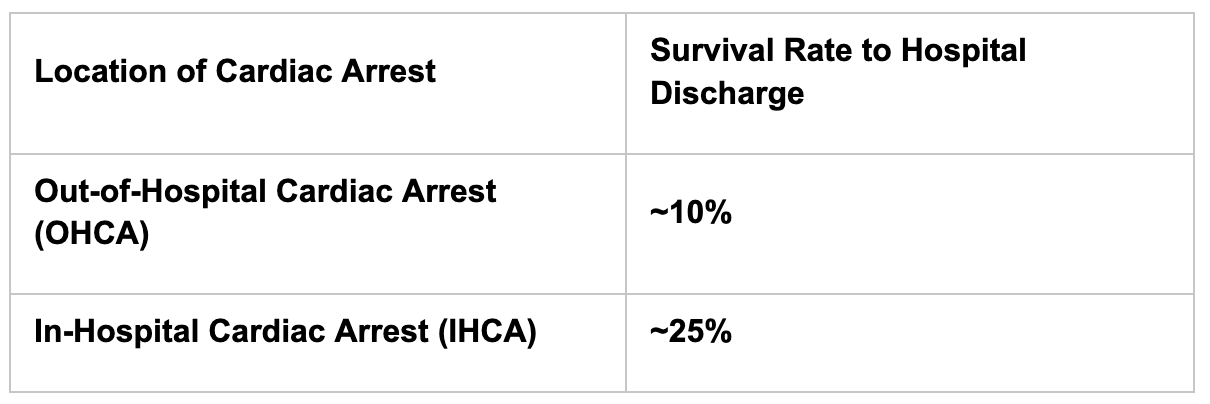
Seeing a ~10% survival rate for cardiac arrests occurring at home or in public can feel shockingly low. However, looking strictly at the final survival rate misses the most critical statistic of all.
What Makes CPR Effective? The Bystander Effect
While 10% is the baseline average for out-of-hospital cardiac arrest, that number shifts dramatically depending on one single factor: immediate bystander CPR.
When someone experiences a cardiac arrest, their chance of survival drops by 7% to 10% for every single minute that passes without CPR or defibrillation. Brain tissue begins to suffer irreversible damage after just 3-5 minutes without oxygen.
The Difference You Make: Performing immediate CPR can double or triple a person's chance of surviving an out-of-hospital cardiac arrest.
Factors That Sharply Boost CPR Success Rates:
Early Recognition & Action: Starting chest compressions within seconds of collapse keeps oxygen flowing to the brain.
Use of an Automated External Defibrillator (AED): CPR keeps blood moving, but an AED is what actually resets a heart in lethal rhythms (like ventricular fibrillation). Using an AED alongside CPR within the first 3–5 minutes can boost survival rates to 50–70%.
High-Quality Compressions: Pushing hard (at least 2 inches deep) and fast (100–120 beats per minute) ensures effective circulation.
Is It Even Worth Doing CPR With a Low Success Rate?
The short answer is an absolute, resounding yes.
It is easy to look at a 10% survival chance and feel discouraged, but you have to reframe what that number actually represents:
Without CPR, the survival rate is near zero. If someone suffers sudden cardiac arrest and nobody intervenes, their chances of survival plummet to virtually 0% long before an ambulance can arrive (average EMS response times range from 7 to 12 minutes, longer if the emergency is remote).
10% represents thousands of living human beings. That ~10% isn't just an abstract statistic—it represents tens of thousands of mothers, fathers, children, and friends who walk out of hospitals every year strictly because a stranger or family member took action.
You cannot make a cardiac arrest victim "worse." Clinically speaking, a person in cardiac arrest is dead without intervention. You cannot make their condition worse by trying—you can only give them a fighting chance.
The Takeaway
CPR isn't a guaranteed miracle cure, but it is a crucial bridge to life. When a heart stops in the real world, hands-only CPR buys the precious minutes needed for emergency medical services to arrive with a defibrillator and specialized medication.
Even if the odds seem stacked against them, taking action gives someone a chance at life when they otherwise have none.
