
Debunking Myths: What Idaho’s Good SamaritanLaws Actually Say (and Protect)
When someone faces a medical emergency—whether it’s a car crash on I-84 or an accidental drug overdose at a house party—hesitation can cost lives. A major reason people hesitate to step in or dial 9-1-1 is legal fear. “Will I get sued if I break someone’s rib doing CPR?” “Will I get arrested if I call 9-1-1 for an overdose when there are drugs in the house?”
In Idaho, Good Samaritan Laws exist to remove those exact fears. However, urban legends and legal misunderstandings still cause dangerous delays. Here is a breakdown of the myths, what Idaho law actually says, and what happens if you step outside your bounds.
Myth vs. Reality: Common Misconceptions
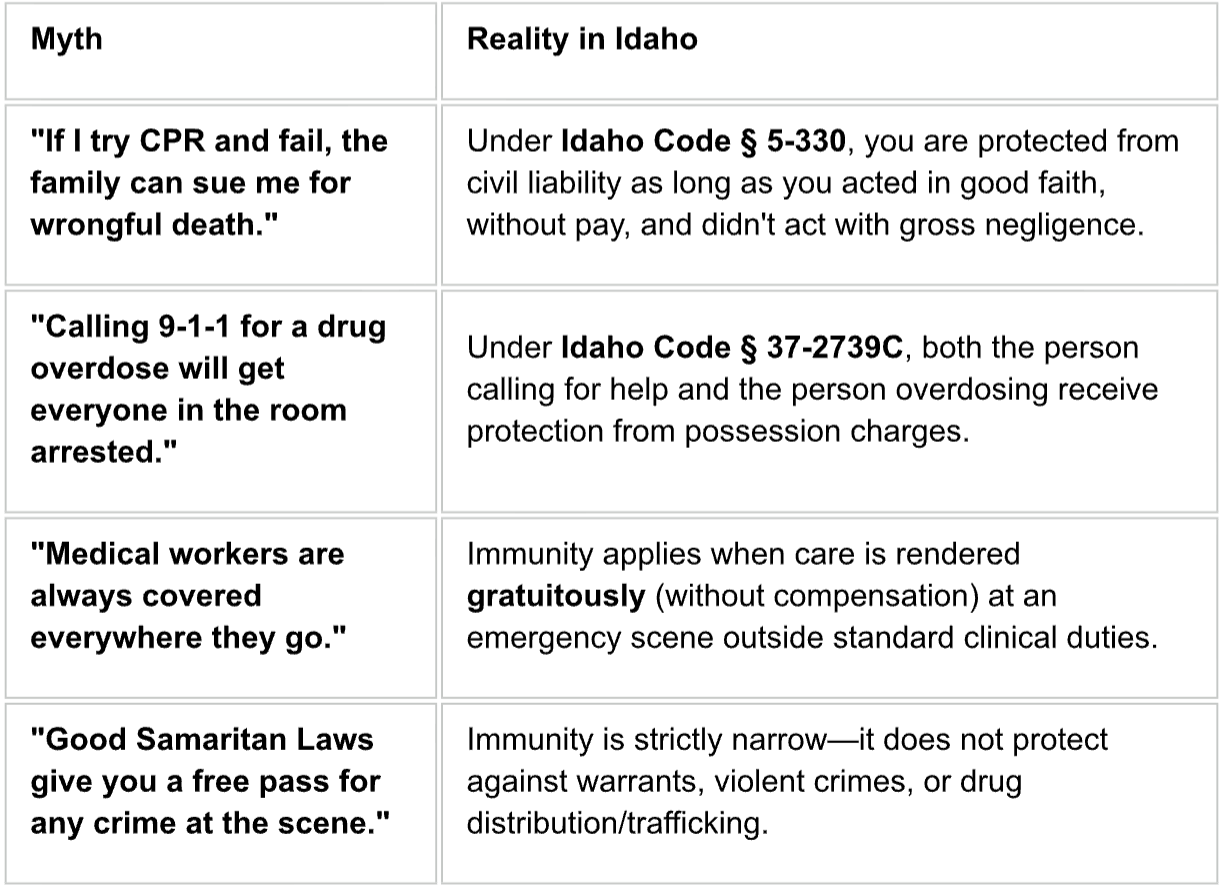
1. Civil Protection: First Aid & Bystander Care
(Idaho Code § 5-330)
Idaho’s standard Good Samaritan statute focuses on civil liability—protecting rescuers from being sued for personal injury or property damage caused while helping someone.
What is legal and covered?
Emergency Assistance: Administering basic first aid, CPR, or using an Automated External Defibrillator (AED) at the scene of an accident or sudden medical collapse.
Naloxone Administration: Laypersons administering opioid-reversal medications like Naloxone (Narcan) to someone experiencing a suspected overdose are legally shielded from civil liability.
Good-Faith Standard: You must act voluntarily, in good faith, and without compensation or expectation of pay.
When does protection end?
Under Idaho Code§ 5-330, civil immunity ends as soon as the injured person is handed over to a hospital, EMTs, or higher medical authority.
2. Basic First Aid Rules Covered Under Idaho Law
To be shielded by Good Samaritan protections while giving basic first aid, bystanders should stick to standard, recognized practices:
Obtaining Consent: If the injured person is conscious and coherent, you must ask for permission before touching or treating them. If they are unconscious, unresponsive, or unable to communicate due to severe injury, Idaho law operates under implied consent—assuming a reasonable person would want life-saving help.
Standard Life-Saving Protocols: Covered procedures include basic wound care (applying pressure or tourniquets to stop severe bleeding), performing chest compressions, delivering rescue breaths, clearing an obstructed airway (Heimlich maneuver), and applying an AED.
No Abandonment: Once you initiate first aid or step in as a rescuer, you establish a duty of care. You must remain with the victim until an equally or more qualified person (like an EMT) takes over. Walking away midway through assistance without a valid safety reason can expose you to legal claims of abandonment or gross negligence.
3. Criminal Protection: The 9-1-1 Overdose Law
(Idaho Code § 37-2739C)
One of the most critical aspects of state law is the 9-1-1 Drug Overdose Immunity statute. In an overdose situation, minutes determine whether someone survives. Fear of law enforcement often keeps people from calling.
How Idaho protects you when calling 9-1-1: When you call 9-1-1 in good faith to report a drug-related medical emergency, Idaho law provides criminal immunity against specific charges:
Protected Charges: You and the person experiencing the overdose cannot be charged or prosecuted for:
1. Personal possession of a controlled substance.
2. Possession of drug paraphernalia.
Required Actions: To maintain this protection, the caller must:
o Call 9-1-1 promptly to report a medical emergency.
o Remain at the scene until first responders arrive.
o Cooperate fully with emergency personnel and law enforcement.
What is NOT protected under the Overdose Law?
The law is designed to save lives, not shield major criminal operations. Protection does not cover:
Drug distribution or trafficking quantities.
Outstanding arrest warrants.
Violent offenses, theft, or weapons charges.
Evidence collected independently outside the medical emergency response.
4. Types of Immunity Covered Under Idaho Law
Idaho law balances encouraging people to help with maintaining public safety through
two primary types of protection:
1. Civil Immunity (Liability Protection): Shields you from financial lawsuits filed by the victim or their family for accidental injury or property damage during first aid.
2. Criminal Immunity (Limited Overdose Protection): Shields rescuers and victims from misdemeanor or low-level drug possession charges when seeking emergency medical care.
5. Who Does the Law Protect?
Bystanders & Everyday Citizens: Untrained individuals who step up to render help during a road crash, cardiac event, or sudden injury.
Overdose Callers & Victims: Friends, family, or bystanders who call 9-1-1 during a drug overdose, as well as the victim receiving care.
Off-Duty Healthcare Providers: Licensed doctors, nurses, or EMTs who provide care outside their clinical setting without getting paid.
6. What Happens If You Act Outside Your Scope?
Good Samaritan Laws offer broad protection, but they are not unconditional. Losing immunity typically occurs in two scenarios:
A. Gross Negligence or Willful Misconduct Standard Good Samaritan statutes protect against ordinary negligence (e.g., bruising ribs while performing proper CPR). However, they do not protect against gross negligence or intentional harm.
Example: Attempting an invasive procedure you have zero training to perform (like attempting an emergency tracheotomy with a pocket knife) when standard pressure or basic airway management was appropriate.
B. Expectation of Compensation
If you charge a fee, demand payment, or provide care as part of your paid job, standard Good Samaritan civil immunity does not apply—you fall under standard professional duty-of-care laws instead.
Key Takeaway
Idaho’s Good Samaritan Laws are structured so that fear of legal trouble should never prevent you from trying to save a life. Whether administering CPR, giving Naloxone, or calling 9-1-1 during an overdose, staying on the scene and acting in good faith keeps both you and the victim protected under state law.
